
The Shift Most Organisations
Underestimate
Most commercial EV charger decisions focus on what happens before installation:
- Capital cost
- Power output
- Technical specifications
The real exposure often appears after the system becomes operational, when vehicles, schedules and energy demand depend on it every day.
At that point, commercial EV charging stops being infrastructure alone. It becomes an operational dependency.
That is where uncertainty becomes expensive.
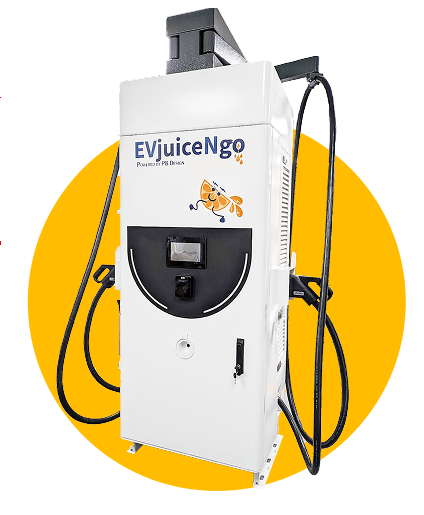
Why Choose EVjuiceNgo Commercial EV Charging Solutions?
-
Fast Commercial EV Charging
Our commercial EV chargers deliver scalable DC fast charging from 60kW to 180kW, with output currents of up to 250A DC for fleet, workplace and public charging applications.

-
Universal Compatibility
Designed to support virtually every electric vehicle, our commercial EV charging solutions feature dual CCS2 250A connectors for reliable, high-performance charging.
-
V2X Charging Technology
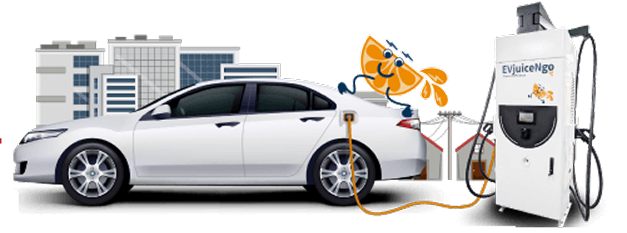
Our commercial EV chargers are designed with V2X (vehicle-to-everything) capability, supporting future bidirectional energy flows between vehicles, buildings and the grid as energy systems evolve.

-
Flexible Payment Options
Our commercial EV charging systems support multiple payment methods, including credit card, RFID and app payments, making them suitable for public and semi-public charging environments.
-
Future-Ready Commercial EV Chargers
With an output voltage range of 200V to 1000V DC, our commercial EV chargers are designed to support today’s vehicles while remaining ready for future charging technologies.
What Actually Drives Commercial EV Charging Costs Over Time
Once a commercial EV charger becomes operationally critical, long-term cost is shaped less by hardware price and more by how systems behave over time.
- How quickly issues are detected
- How clearly responsibility is defined
- How predictably problems are resolved
- How often internal teams are pulled into escalation
When these elements are unclear, small technical issues can quickly become operational disruption.
Downtime is rarely just technical. It becomes organisational, affecting schedules, resources and confidence in your commercial EV charging infrastructure.
Over time, the difference between a commercial EV charger that performs consistently and one that doesn’t becomes increasingly expensive.
Our approach focuses on making commercial EV charging:
- Predictable
- Diagnosable
- Supportable
- Accountable
When something goes wrong, outcomes should be clear rather than disputed. We remove ambiguity so organisations can manage commercial EV charging with confidence.
Download the
EVjuiceNgo
product brief…

Designed for Long-term Operation
EVjuiceNgo is powered by PB Design, with more than 45 years of experience designing and supporting mission-critical DC power systems. That experience shapes our approach to commercial EV charger design: failure cannot be ignored, diagnosis must be evidence-based and accountability must be clear.
As fleets electrify, commercial EV charging infrastructure becomes part of daily operations. The challenge is no longer just installation, but how systems perform over time, particularly when conditions are not ideal.
We apply the same engineering discipline to fleet charging environments, focusing on predictability, diagnosability and how issues are understood and resolved in practice.
When you are assessing how a commercial EV charger will perform once it becomes operationally critical, we are always open to a conversation.
Our HistoryUnderstanding V2X Charging Technology
V2X charging (Vehicle-to-Everything) allows electric vehicles to exchange energy with the wider power system. Instead of a one-way flow, EV batteries can return power to buildings, sites or the grid when needed.
This bidirectional capability allows EVs to act as distributed energy assets, helping balance demand, support local infrastructure and improve energy resilience.
As EV adoption grows, V2X charging is expected to play an increasingly important role in how power is stored, distributed and managed across connected energy systems.


EVJUICENGO CHARGER DETAILS
| Scalable and Upgradeable | Choose from 60kW to 180kW to suit your needs. Up to 400kW coming soon. |
| High Output Current | Up to 250A DC for fast EV charging. |
| Wide Output Voltage Range | From 200V to 1000V DC to accommodate future technologies. |
| 3-Phase Electrical Install | Ensures efficient energy distribution. |
| Parallel DC Charging | Simultaneous charging of multiple EVs. |
| Payment Processing | Credit card, RFID, and app payments. |
| Compliance | IEC & UKCA compliant. |
| Compact and Modular Design | Standard compact footprint with modular components. |
| Dimensions | H1750mm, W775mm, D590mm. |
| Made in the UK | Proudly manufactured in the South West, supporting British manufacturing and job creation. |

Commercial EV Charging Infrastructure Rarely Fails on Day One
It fails quietly over time through ambiguity, misalignment and slow escalation.
If your commercial EV charging infrastructure is becoming operationally critical, we’re always happy to have an exploratory conversation.
Frequently asked questions
What is a commercial DC charger?
A commercial DC charger converts alternating current from the site into direct current inside the charger, then supplies that energy to a compatible vehicle battery. Because the conversion happens outside the vehicle, DC charging can deliver more power than many AC arrangements. It is commonly used where vehicles have shorter dwell times, higher daily energy needs or need to return to service quickly. The actual charging rate still depends on the vehicle, battery state, temperature, charging curve and available site power.
When should a commercial site consider DC charging instead of AC?
DC charging is worth considering when the energy a vehicle needs cannot be delivered within the time it is normally parked. That may apply to fleet vehicles returning between shifts, pool or service vehicles used several times a day, or sites with a high turnover of drivers. AC can remain a sensible option for vehicles parked for long, predictable periods. The decision should be based on dwell time, energy demand, vehicle capability, site capacity and the operational consequence of a missed charge.
What power ratings are available from EVjuiceNgo?
EVjuiceNgo currently offers scalable DC charging options from 60kW to 180kW, with output of up to 250A DC and a stated voltage range of 200V to 1000V DC. The most suitable rating depends on the connected vehicles, their charging windows, the site’s electrical capacity and how power needs to be shared. A charger’s maximum rating should not be treated as a guaranteed charge rate for every vehicle or every session.
Can an EVjuiceNgo charger charge more than one vehicle at a time?
EVjuiceNgo supports parallel DC charging, allowing more than one vehicle to be connected and charged at the same time where the selected configuration allows it. The power available to each vehicle will depend on the charger setup, the vehicles’ own acceptance limits, the available site capacity and any load-management rules. These factors should be agreed during system design so that shared charging supports the real return and departure schedule.