Article Published: 30th January 2026
The real cost of DC EV Charging for fleets isn’t the charger price
DC charging infrastructure is rapidly shifting from a supporting asset to a core operational dependency.
Download the Whitepaper Now >Chargers are no longer powering pilot projects or limited trials. They now underpin vehicle availability, route planning, shift patterns, and service delivery. When charging performs reliably, operations run smoothly. When it doesn’t, the impact is felt quickly, and often disproportionately.
Many fleet charging decisions are still made primarily on:
- Upfront cost
- Power levels
- Headline specifications
The question fleets often discover later is a simple one; What happens after the chargers are installed and relied upon day to day? That question is rarely answered clearly at procurement stage, but it is often where the true cost of DC charging begins to emerge.

Why upfront price is a misleading starting point
It’s understandable why charger price dominates early discussions.
Capital costs are visible, comparable, and easier to justify internally. But in practice, DC chargers behave less like static assets and more like operational systems.
Once deployed, they:
- Operate continuously, often in constrained or high-utilisation environments
- Support time-critical vehicle availability
- Rely on software, connectivity, and external services
- Require ongoing maintenance and intervention
- Interact with site infrastructure and third-party providers
As a result, the initial hardware cost typically represents only a fraction of long-term exposure.
Fleets that optimise purely for purchase price are not making poor decisions, they are making decisions based on not being able to see the full picture. Many of the costs that matter most only surface once charging becomes embedded in their daily operations.
What total cost of ownership really looks like in fleet charging
Total Cost of Ownership (TCO) extends well beyond hardware and installation.
It typically includes:
Capital Costs
- Charger hardware
- Installation and commissioning
- Site preparation and electrical works
Operational Costs
- Preventative and reactive maintenance
- Software licensing and updates
- Monitoring and diagnostics
- Service interventions
Indirect Operational Costs
- Vehicle downtime
- Manual workarounds during outages
- Disrupted routes or shifts
- Staff time managing faults and escalations
- Internal scrutiny when service levels drop
While capital costs are immediate and visible, indirect costs tend to accumulate quietly over time, often becoming material only once charging is business-critical.
Many fleets discover that long-term cost is shaped less by what they bought, and more by how predictable and supportable the system proves to be under real operational conditions.
Downtime isn’t linear, and that matters
Downtime is often discussed in percentages or uptime figures. In reality, it is experienced operationally.
When DC chargers are unavailable, fleets may face:
- Vehicles queuing or remaining undercharged
- Manual reassignment of assets
- Temporary reliance on public charging
- Increased administrative overhead
- Pressure on operations and fleet teams
Here’s the part that often gets missed:
A single prolonged outage during a critical operational window can outweigh weeks of minor interruptions. Timing, duration, and context matter far more than frequency alone.
This is why “99% uptime” can still translate into real operational pain if failures are poorly timed or inconsistently handled.
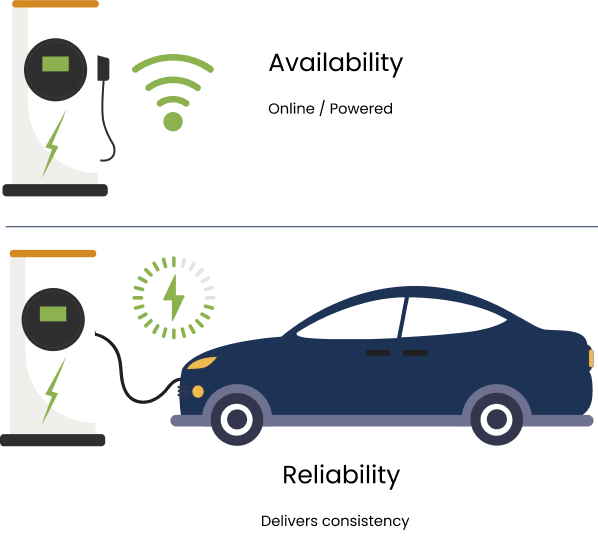
Reliability and availability are not the same thing
Uptime and availability are often used interchangeably, but for fleet operators, they describe very different realities.
- Availability refers to whether a charger is technically online or powered.
- Reliability reflects whether it consistently delivers charging when required, without intervention.
A charger can be available while still failing operationally due to:
- Intermittent communication issues
- Software errors
- Reduced performance under load
- Inconsistent session initiation
For fleets, reliability is not a statistic. It is an outcome.
The operational test is simple:
When a vehicle needs to charge, does it? And if it doesn’t, is the issue resolved predictably?
As utilisation increases, this distinction becomes increasingly important.
SLAs don’t remove risk, being clear does
Service Level Agreements play an important role in fleet charging contracts, but they are often misunderstood.
SLAs typically define:
- Response times
- Resolution targets
- Scope of coverage
What they don’t always define clearly is how issues are handled in practice.
Fleets frequently find that operational outcomes are shaped less by the SLA itself, and more by:
- How quickly issues are diagnosed
- How clearly responsibility is defined
- How consistently communication is maintained
- How predictable escalation paths are
An important realisation many fleets reach is this:
SLAs define expectations, but they do not remove operational risk.>
In practice, clarity of process and responsibility often has a greater impact on outcomes than response times alone.
A useful lens: The 3 Cs of operational charging
Across many fleet environments, long-term cost and reliability tend to be shaped by three recurring factors:
Clarity
How clearly responsibility, escalation paths, and expectations are defined when things go wrong.
Consistency
How predictably issues are detected, communicated, and resolved over time — not just once, but repeatedly.
Consequences
How downtime and underperformance actually affect operations, schedules, and internal accountability.
Charging decisions that overlook any one of these often become more costly and disruptive over time, even when the hardware itself performs as expected.
This framework helps fleets evaluate charging infrastructure beyond initial procurement, without relying on headline specifications alone.
Where problems typically emerge over time
Long-term challenges rarely arise from a single failure.
They tend to emerge from recurring patterns once chargers are in regular use, including:
- Limited visibility into faults or system status
- Unclear ownership during incidents
- Variability in service response and communication
- Inconsistent commissioning or handover
- Assumptions that no longer hold as fleet size or utilisation grows
These issues are not unique to any one supplier. They are characteristic of complex systems operating at scale.
Understanding where friction commonly arises allows fleets to evaluate solutions more realistically, not by expecting perfection, but by reducing avoidable uncertainty.
Designing for resilience, not just deployment
Fleet electrification is rarely static.
As vehicle numbers grow, duty cycles evolve, and operational demands change, charging infrastructure must adapt.
Early decisions influence:
- Scalability
- Maintenance complexity
- Service costs
- Internal confidence in electrification strategies
Most fleets do not regret electrifying.
Some regret how early charging decisions constrained them later.
What happens after installation is rarely determined by a single specification or contract, but by how reliability, serviceability, and responsibility are handled once conditions are no longer ideal.
Using this perspective in practice
DC charging infrastructure is no longer an experimental add-on for fleets. It is a core operational asset with real financial and organisational consequences.
Understanding Total Cost of Ownership means recognising that:
- Purchase price is not total cost
- Availability does not always equal reliability
- SLAs do not remove risk on their own
- Ambiguity often drives operational pain
Many fleets use this perspective to structure internal discussions, evaluate suppliers more consistently, and reduce avoidable friction over the life of their charging assets.
Every fleet environment is different, but informed decisions are more likely when expectations are realistic, responsibilities are clear, and long-term outcomes are considered from the outset.
Download the WhitepaperFinal note
This article is intended to support informed evaluation and constructive dialogue around fleet DC charging, not to promote a specific product or approach.
As charging infrastructure becomes more embedded in daily operations, the questions fleets ask early will increasingly shape the outcomes they experience later.